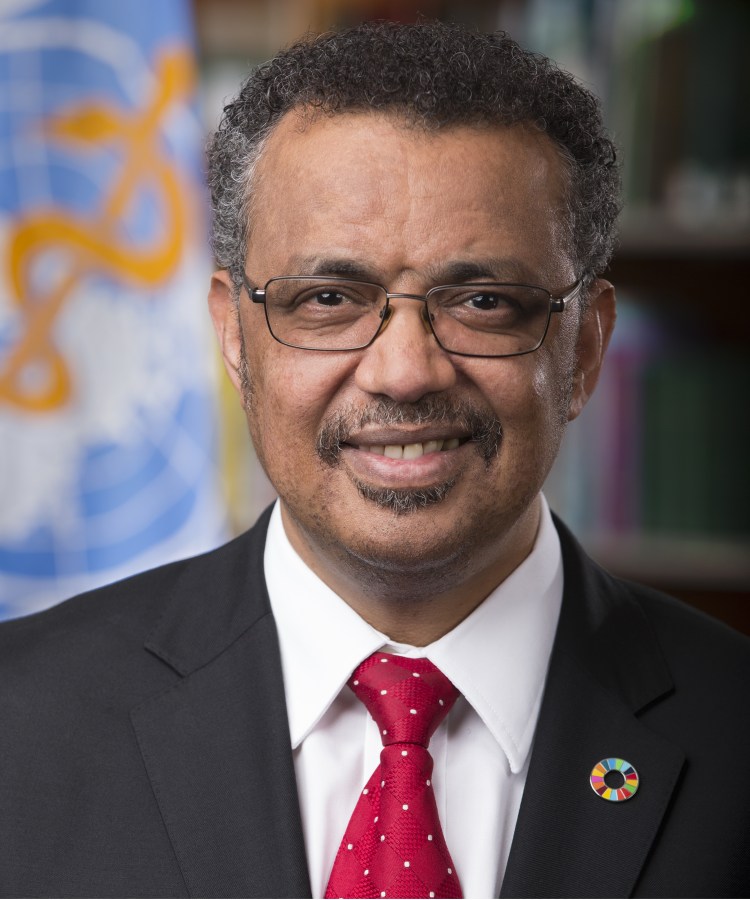
(official WHO photo)
One of the international public figures thrust into the limelight during this crisis has been Dr Tedros Adhanom Ghebreyesus, the Director-General of the World Health Organisation. We’ve got used to him appearing on our screens telling the world to test, test, test. Many have praised his interventions.
However, Dr Tedros has faced criticism for being too effusive in congratulating China on its aggressive efforts to contain the virus in Wuhan. Some also believe he may have been too slow in declaring the outbreak as a global pandemic.
I know of Dr Tedros from Ethiopia where he was the health minister and then foreign minister before taking up the WHO job. But he also has a strong abiding link to the UK. I discovered this when I was part of a production team which met him several years ago in the Ethiopian capital, Addis Ababa.
Dr Tedros gave us an interview about his enduring gratitude to his academic alma mater, the London School of Tropical Hygiene and Medicine. He was affable and approachable as others have witnessed. But, of course, a range of more steely attributes is needed to withstand the pressures of his current position.
However, the WHO is clearly much more than its top leadership. Its experts have been at the centre of handling this pandemic from the start. They have facilitated some vital international co-operation in fighting the disease.
The WHO’s relations with China have been crucial. As we know, at the end of last year, the Chinese government covered up the existence of the virus. Eventually though it did come clean by informing the world, via the WHO. This short WHO document gives an authoritative primary source record of the timeline of these contacts.
The timeline shows that China first notified the WHO Beijing office about the emergence of a new virus on 31 December 2019. But crucially, on 12 January this year, China passed on to the WHO details of the genetic sequencing of the coronavirus. This enabled scientists across the world to develop tests for it. To start early work on a vaccine and begin to examine whether some existing antivirals could mitigate the effects of the virus.
Another crucial document from the WHO is this mind-blowing report from one of its teams of medical and scientific experts. They visited China in mid-February to examine the drastic methods used to contain the virus. The draconian tactics involved introducing immediate and extreme measures. Locking down Wuhan and greatly increasing the number of ICU beds and protective equipment in the city. And, in the rest of China, employing ambitious radical initiatives to prevent the spread of the virus through rigorous, speedy testing and mass contact tracing.
Several of these authoritarian and highly-intrusive measures made many democratic governments squeamish at the time. But the world had been warned that desperate times needed desperate measures. Did enough countries take note early enough?
If you do read this WHO report on the Chinese approach, I suspect that, like me, you may well have some subdued moments of reflection. Perhaps you may come to realise, like I did, how much effort and sacrifice all of us may have to continue to make if we are to contain the pandemic.
 globalwindow