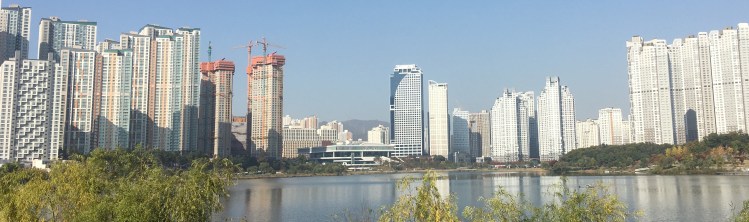
I’ve been meaning to write this post for some time. Given my two sons are currently living in South Korea, I do know the country a little. I was last there in November 2019 when I stayed with my elder son Phil, who lives near Seoul.
Despite its traditional roots, South Korea is a very modern, developed country with sophisticated medical and scientific facilities. Something we have become increasingly aware of as the coronavirus pandemic has unfolded. We have often been told South Korea is a great example to the world because of its relatively low infection rates due to widespread testing and contact tracing.
What I hadn’t really realised is how much of an example it really is and why the rest of the world hasn’t been paying even more notice. Two statistics made me sit up with a jolt in the last few days. One is that Seoul, a huge dynamic city of nearly 10 million people, has only seen two deaths from the virus.
The other is that South Korea has only ever had recorded new deaths in single figures on every single day since the outbreak began. When I first heard this statistic I couldn’t quite believe it but after double-checking the figures I can confirm it is true.
However, the most striking statistic is that the overall death figure in South Korea is today just 236. This is at a time when tragically the comparable figures are: United States 40,565 deaths; Italy 23,660; Spain 20,453; France 19,718; UK 16,060.
Obviously, this is a staggering comparison, especially with South Korea being so close to China and recording its first case in mid-January. Some scientific experts have been making the case that it is difficult to compare the figures from different countries. This is because of the difference in factors such as population size and density, cultural and economic issues, and medical and public health considerations.
Some experts also say it is still too early to judge the impact of the pandemic on each individual country and we may have to wait for a year or so to see how the situation is then.
Well maybe, but the gap here is so huge that it is hard to explain away easily. South Korea is densely populated with around 50 million people in total. Compare that to about 47 million in Spain, around 56 million in England, about 60 million in Italy and about 67 million in France.
You can put this another way. South Korea has a recorded death rate of just 5 per million of its population. Compare that to Belgium (490) Spain (437) Italy (391) France (302) UK (237). America with its huge population has a rate of 123 deaths per million.
All this begs a big question. Why haven’t countries in Europe and the United States been ruthlessly employing the tactics of South Korea in pre-emptive diagnostic testing and large-scale contact tracing? Sadly, the countries mentioned would appear to have largely missed the boat in doing this for the first wave of infections.
For example, the UK gave up surveillance testing and contact tracing in the wider community on 12 March when it had just 596 cases. It now has more than 120,000. On 12 March South Korea had nearly 8,000 cases and has continued to test in a targeted way in the community extensively ever since. It now still has only around 10,700 cases.
Germany is one country in Europe which has sought to closely follow a pre-emptive testing approach. Is it any surprise that its death toll of 4,642 is much lower than its main European counterparts? This is around one-fifth of the total of deaths in Italy.
Most of the outbreak in South Korea has been confined to the southern city of Daegu and neighbouring North Gyeongsang province. The South Korean public health authorities have had a laser-focus approach on preventing the spread. If any individual tests positive for the virus, then a determined operation is put in place to trace, test and treat. This works by all contacts of the infected person being chased down through a high-tech app, plus phone calls from health officials.
The contacts are asked to go for a test at a nearby centre and then to stay at home in quarantine for 14 days, even if the test is negative. They are then tested again at the end of this period. All these contacts are given details about how to download the app and sent a special package. This includes several masks, hand and spray sanitizer, big bin bags and a thermometer. The contacts have to fill out their symptoms on the app twice a day.
The South Koreans have officially shared their best practice and experiences with the rest of the world over the past few weeks. What is surprising is that they have managed to largely contain the virus while keeping most of the country open since the start of the outbreak. Most shops, gyms and transport links have been operating throughout. However, schools have remained shut.
Just today the South Korea has eased several of its remaining restrictions on the movement of its population. See this Reuters report.
All this comes as European countries and the US struggle to work out how they can emerge from lockdown while they still have relatively high infection and death rates. There are signs that in several countries the lessons from South Korea about testing in the community and contact tracing are beginning to be heeded. But it all seems a little hesitant and slow-moving whereas the main lesson from South Korea would seem to be to act as boldly and decisively as soon as possible.
It maybe that some of South Korea’s surveillance methods are too radical for some European cultures but there can be little doubt its strategy has worked so far. The figures are overwhelming. But has the South Korean example really been studied and followed closely enough?
What is even more surprising is that there is another Asian country that has an even better record of containing the virus. Taiwan, a country of 24 million in close proximity to China, has recorded just an astonishing 422 cases with only six deaths. Why isn’t its strategy more widely known and examined?
 globalwindow