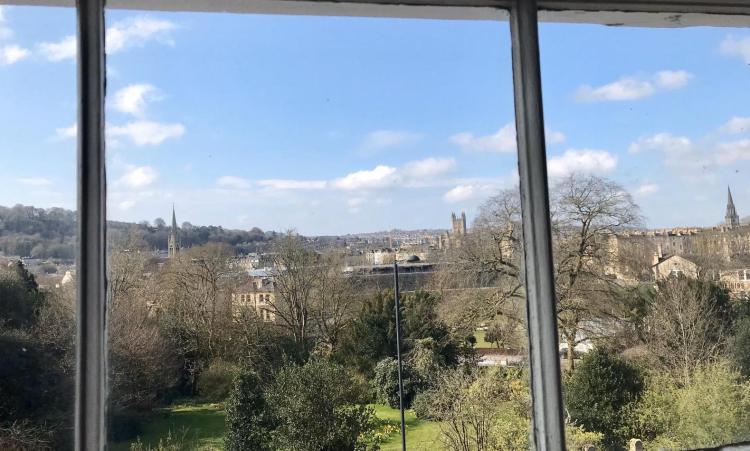
View from my window in early May (Photo:Keith Bowers)
In the last few days all the leaves have fully come out transforming the view from my apartment. The copper beech tree glistening in the morning sun is a special delight. The arrival of Spring always brings hope. Quite a contrast to what I could see from my window towards the end of March when I started this blog.
Early lockdown view on 28 March (Photo:Keith Bowers)
A lot has also changed in the course of the pandemic since my first blog post. Then many countries around the world were near the start of their drastic lockdown measures. Now many of them are talking about gently easing restrictions, though of course the crisis is far from over.
On 28 March there were around global 664,000 official cases of the virus. Now there are more than 3.5 million. Many people have died since then but many more have recovered. Hopefully we are now five weeks closer to finding a vaccine too.
Before today I had written 20 posts for this blog. So time to take stock. My aim was always to give a global perspective, including from individual primary sources. Hopefully I am on track. You can see from the thumbnails below that I have mentioned people, organisations and developments from all over the world.
Images from across the world (various sources)
Many people apart from me have been posting photos of the view from their windows during lockdown. If you have a few minutes to spare, I can recommend scrolling through some of these great photos from across the globe. You can find some of them on Instagram and on Facebook
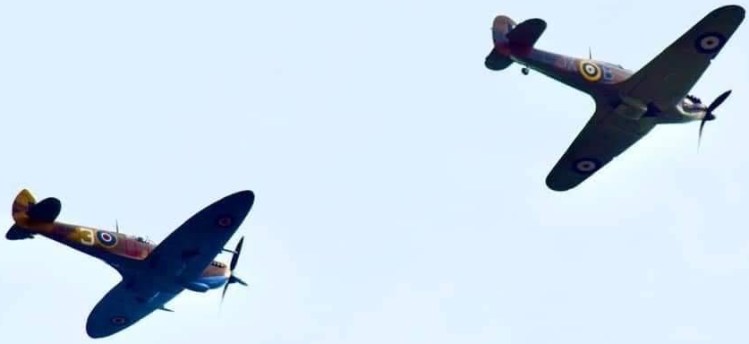
Fly-past to celebrate a special 100th birthday (Photo: Jilly Bozdogan)
The 100th birthday of Captain Tom Moore from Bedfordshire was celebrated around the world yesterday. He’s become a global phenomenon after raising more than 32 million pounds for Britain’s health service by doing a sponsored walk involving a hundred laps around his garden.
Captain Tom has received more than 125,000 birthday cards from across the globe and has also been awarded the prestigious World Health Organisation Medal.
The fly-past in his honour was carried out in classic British fashion by two planes from the second world war era.
A Hurricane and Spitfire lead the birthday tributes (Photo: Jilly Bozdogan)
Captain Tom’s house is about 50 miles north of London in the village of Marston Moretaine. It’s in the Bedford area where I lived for many years. So I can easily imagine those two old aircraft in the cloudy skies yesterday above the clay-rich plain where Marston Moretaine sits. I’m grateful for the use of these photos which were taken by a neighbour of Captain Tom’s.
His determined fund-raising efforts have inspired many people to follow suit, including three amazing people from the west of England where I now live. I saw their stories on the local Points West BBC programme and wanted to share them with you.
Frank Mills from Bristol is just six years old and has spina bifida. He has been using his walking frame to walk repeatedly on a ten-metre track outside his home. So far he has raised more than 260,000 pounds for the NHS. You can read more about him here.
Ed Jackson is a 31-year-old former professional rugby player who was paralysed in all four limbs after an accident in a swimming pool. Despite that, as a walking quadriplegic, he still hopes to climb Mount Everest one day.
During this lockdown at his parents’ house in my home city of Bath, Ed decided to climb the flight of stairs 5,566 times to match the height of Everest. This is 8,898 metres above sea level, the equivalent of 89,056 individual steps. It took Ed four days to finish this task. So far he has raised more than 45,000 pounds for the NHS and a spinal cord charity.
Mike Biggar is 70 and is a former Scotland rugby captain. He suffered severe brain damage in 1992 in a car crash and has very limited walking capability. His fund-raising scheme was to walk 500 steps in a month. Mike lives in the town of Malmesbury in Wiltshire and so far he has raised more than 50,000 pounds.
These are just three examples of people in my region wanting to contribute to society at a time of crisis. Everyday I see or hear about stories of local men and women, boys and girls, doing heart-warming voluntary work behind the scenes. This includes making protective equipment for front-line health workers, delivering food to the vulnerable or making supportive phone calls to those stuck in their homes alone with no family support.
These acts of generosity are replicated countless times across the world during this pandemic. The giving spirit is truly alive and well.
We were all outraged when Dr Li Wanliang was reprimanded by the Chinese authorities for telling the truth about the onset of an unknown disease in Wuhan last December. Dr Li was doing his duty and wanted to warn the public about an imminent threat to public health. Instead he was investigated by the police for allegedly spreading false rumours.
In the end Dr Li was proved right as Covid-19 was identified as a new disease. But tragically he later died after contracting the virus while working to help patients in Wuhan. Today he is remembered across the world as an icon – someone who spoke truth to power.
Sadly, Dr Li is not the only person who has been victimised for telling the truth about Covid-19. I can think of several examples just in the United States and the UK where I have been closely following the growth of the pandemic. There may well be countless others across the world who have spoken out but have suffered in silence.
One of the first American public health figures to raise the alarm about the threat of the virus was Dr Nancy Messionnier. She is the top expert on viral respiratory diseases at the CDC, the Centers for Disease Control and Prevention.
At the end of February she gave what is now an infamous press briefing in which she said she wanted to make sure the American public was prepared for the disruption the virus would cause. She said parents should ask the heads of their children’s schools about their plans for closing them down as the pandemic grew worse.
Her comments caused uproar and led to a fall in the stock market. President Trump was reportedly furious. His business adviser, Larry Kudlow, replied to Dr Messionnier’s comments by falsely saying the virus was contained – not airtight but pretty close to airtight.
Recent reports have indicated that the President even wanted to fire Dr Messionnier for her truthful warning. That did not happen but her role in public briefings has since disappeared.
Even last week the Director of the whole of the CDC, Robert Redfield, also uttered an inconvenient truth. He was forced by President Trump to walk back his comments that the assault of the virus on the nation next winter would cause more difficulties than this past one.
In the UK, we are also seeing the government being discomfited by inconvenient truths. There is evidence that the authorities have been trying to silence doctors and nurses, who have rightly been complaining about the lack of adequate protection equipment on Covid-19 wards.
In this excellent must-see BBC Panorama documentary this week, one senior nurse said she was prepared to speak about this issue as she was a union rep. She said didn’t want any more health workers to come to harm.
The UK government’s strategy over the handling of the pandemic has been criticised in the past few weeks by several prominent public health experts. One of them is Devi Sridhar, the Professor and Chair of Global Health at Edinburgh University’s Medical School.
She has spoken out in support of countries like South Korea which have put a lot of emphasis on pre-emptive community testing and contact tracing. Here is one of her opinion pieces last month accusing the UK government of dithering and lack of transparency. On national television a few days ago she said bluntly that Britain had made a mess of its pandemic response.
Earlier this week the Professor revealed on her twitter feed that she had been getting into trouble for her tweets. She said she would be taking a break for a while to share baking recipes and cat videos – hopefully that would be more acceptable.
However, she later indicated that she had been overwhelmed by messages of support for her views and analysis. The Professor now said she had changed her mind about being quiet and keeping her head low. She is once again seeking to tell truth to power, though this may come at a cost in the possible loss of future grants.
Many politicians around the world have said we are now in a war against the virus. As the famous saying goes, the first casualty in any war is truth. It’s no different in this pandemic as inconvenient truth-tellers come under increasing pressure.
Computer generation of Covid-19. Image: Wikimedia commons
Have you got clear in your own mind what the origin of Covid-19 was? One strong initial belief around the world was that the virus originated in a wet market in Wuhan. The consensus was that it came originally from bats, possibly through pangolins as intermediaries.
However, there are other theories of course. According to a recent King’s College survey in early April, 25 per cent of the British public believe the virus originated in a lab. On the fringes, we have had the spread of conspiracy theories such as the virus was caused by the introduction of 5G mobile phone technology. Or, according to some Chinese officials, that it was American soldiers who originally brought the virus to Wuhan.
One authoritative scientific study published last month in the Nature Medicine journal has already given an indication that the origins of the virus may not be as straightforward as originally thought. It concluded that there was no evidence that the virus was created in a laboratory or otherwise engineered. Instead, the study says Covid-19 is the product of natural evolution. The full article is very complex but you can also read a summary of its findings here.
Other new information is cropping up all the time. Germany’s leading coronavirus expert, Christian Drosten, has offered a different perspective. He said he didn’t assume that the virus originated at a Wuhan food market but it was more likely to have been where the animal – the intermediate host – was bred.
His belief is that it could well have been raccoon dogs that were the hosts, not pangolins. The relevant answers are half way down an interview published yesterday but it’s worth reading the whole of it. Drosten has some fascinating insights on herd immunity, and why Angela Merkel’s scientific background makes her a good leader during this pandemic crisis.
In the light of all this wide-ranging information I am trying to keep an open mind. More information and possible evidence is likely to emerge in the months ahead. It’s important to be on one’s guard when various individuals and interest groups are trying to push their own theories for political and other reasons.
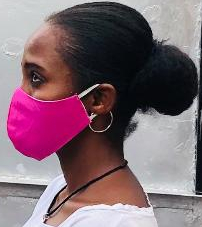
An Arakele mask in Ethiopia (Photo: Arabella Stewart)
It’s very uplifting to see how so many individuals and groups around the world are doing their bit to help fight the pandemic. I want to mention just one example today. Others will follow.
My friend Arabella in Addis Ababa runs a social enterprise called Arakele. Its aim is to train primarily marginalised women from a range of diverse backgrounds to sew and design clothes. After the students graduate from Arakele’s Fashion and Design College, they are helped to find jobs in which they can use their newly-acquired skills.
Classes at the college have been closed for some time due to the coronavirus. However, staff members are now using their creativity to help the college survive financially and add to the collective effort to combat the virus. They have been using the college’s sewing machines to make a range of washable and breathable cotton masks.
Ethiopia has joined many other countries in advocating the wearing of face coverings when out in public spaces. However, the government says specific surgical masks should only be used by medical staff.
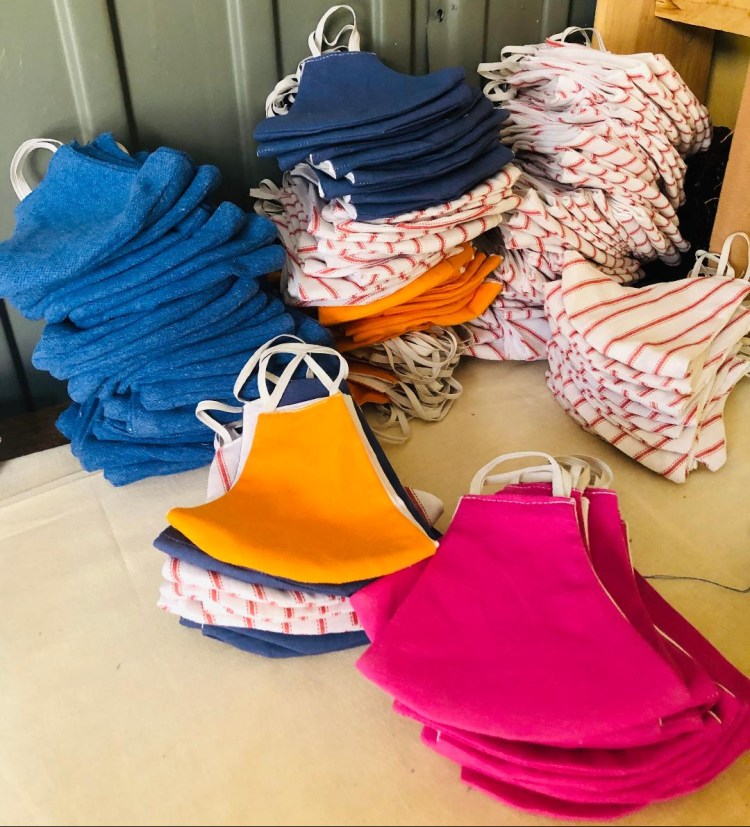
Arakele masks in a range of colours (Photo: Arabella Stewart)
Arakele’s masks are made from two layers of cotton with elastic ear loops. There has already been interest from France, England, Wales and Norway to buy these masks. The college has now started making hospital gowns as well.
Arakele is also making masks to give free to people in need in Ethiopia. If you would like to support this initiative please give money through Paypal. More details at http://www.arakeleplc.org/supportarakele
The college can also send masks directly to customers abroad (producing and delivering within 10 days) via EMS (DHL). Orders are being done by email. arakeleplc@gmail.com
In the past many organisations have sponsored students to learn at Arakele’s Fashion and Design College. These include Plan International, International Fund for Africa, Hope for Children, and the Association for Women’s Sanctuary and Development.
I hope you’ll forgive another blog post focusing on the death rates caused by the pandemic. I am all too aware of how these statistics represent so much individual sorrow and suffering. It’s therefore always vital to keep that in mind when analysing data.
However, my recent post about South Korea’s low death toll got me thinking about the overall global position. And I am equally amazed by what story these figures appear to be telling. So please allow me one more blog about the statistics and then I will leave well alone for a while.
Put simply, why is there such a huge discrepancy in the Covid-19 death rates between east Asia and western Europe? For example, how is it that the death toll in five major European countries (Italy, Spain, France, UK, Germany) is so far nearly 90,000? Whereas in five major east Asian countries (Japan, South Korea, Thailand, Taiwan and Malaysia) the number of deaths is so far less than 700?
The combined populations are nearly the same: around 320 million against around 300 million. So let me repeat that headline figure. Nearly 90,000 deaths against less than 700.
Of course, I have to add some caveats. These official figures may not be reflecting the whole story, things could change drastically over the coming months and there are some cultural, structural and other differences between the various countries. However, this is still a staggering contrast isn’t it?
Four of the five European countries mentioned above are in the G7, the group comprising the majority of the most advanced economies on the planet. However, in passing, I should be fair to Germany whose death toll is much lower than the other four mentioned.
You will see that I haven’t so far mentioned the biggest member of the G7 – America, the richest country on earth, which currently has more than 45,000 deaths. I also haven’t yet referred to China, the world’s second richest country. It has officially reported just 4,632 deaths, though some believe this may be too low an assessment.
The burning question is this. Why are many Asian countries succeeding in saving the lives of more of their citizens than many nations in Europe and the US? The common denominators in Asia are widespread pre-emptive community testing, rigorous contact tracing and effective pandemic planning. There may well be a host of other reasons.
Whatever the explanations, I find these comparisons increasingly disturbing. Many western governments would appear to have missed the boat in protecting their populations effectively in the first wave of the virus. But, as Europe is preparing to ease its lockdown restrictions, are we taking radical action now to implement what would appear to be the obvious lessons from Asia? Can we be satisfied with just flattening the next curve rather than trying to crunch it?
Finally, let me zoom out still further and give the overall summary of death figures for the whole world. These are taken from the reliable Worldometer database I have mentioned before.
Today the global figures of reported deaths are: Europe 108,003: North America (including the Caribbean) 48,613: South America 4,336: Asia (including Turkey, Iran and the Middle East) 15,523: Africa 1,197: Oceania (including Australia and New Zealand) 88.
There are many revealing and worrying narratives lurking in these figures. However, one neglected area is Africa where there are fears that countries with undeveloped health systems could be overrun in the months ahead.
Yesterday the United Nations also warned that the current collapse in the global economy could lead to an increase in famines breaking out in parts of the developing world and a general rise in poverty levels. In a future blog I hope to look at what is being done to mitigate these problems.
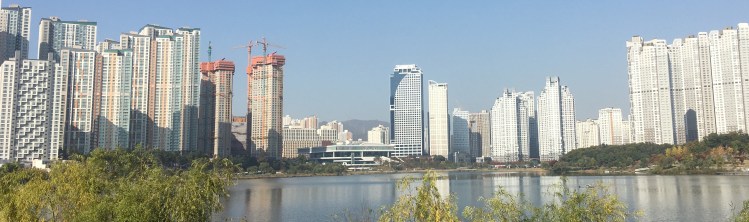
A modern suburb south of Seoul (Image: Keith Bowers)
I’ve been meaning to write this post for some time. Given my two sons are currently living in South Korea, I do know the country a little. I was last there in November 2019 when I stayed with my elder son Phil, who lives near Seoul.
Despite its traditional roots, South Korea is a very modern, developed country with sophisticated medical and scientific facilities. Something we have become increasingly aware of as the coronavirus pandemic has unfolded. We have often been told South Korea is a great example to the world because of its relatively low infection rates due to widespread testing and contact tracing.
What I hadn’t really realised is how much of an example it really is and why the rest of the world hasn’t been paying even more notice. Two statistics made me sit up with a jolt in the last few days. One is that Seoul, a huge dynamic city of nearly 10 million people, has only seen two deaths from the virus.
The other is that South Korea has only ever had recorded new deaths in single figures on every single day since the outbreak began. When I first heard this statistic I couldn’t quite believe it but after double-checking the figures I can confirm it is true.
However, the most striking statistic is that the overall death figure in South Korea is today just 236. This is at a time when tragically the comparable figures are: United States 40,565 deaths; Italy 23,660; Spain 20,453; France 19,718; UK 16,060.
Obviously, this is a staggering comparison, especially with South Korea being so close to China and recording its first case in mid-January. Some scientific experts have been making the case that it is difficult to compare the figures from different countries. This is because of the difference in factors such as population size and density, cultural and economic issues, and medical and public health considerations.
Some experts also say it is still too early to judge the impact of the pandemic on each individual country and we may have to wait for a year or so to see how the situation is then.
Well maybe, but the gap here is so huge that it is hard to explain away easily. South Korea is densely populated with around 50 million people in total. Compare that to about 47 million in Spain, around 56 million in England, about 60 million in Italy and about 67 million in France.
You can put this another way. South Korea has a recorded death rate of just 5 per million of its population. Compare that to Belgium (490) Spain (437) Italy (391) France (302) UK (237). America with its huge population has a rate of 123 deaths per million.
All this begs a big question. Why haven’t countries in Europe and the United States been ruthlessly employing the tactics of South Korea in pre-emptive diagnostic testing and large-scale contact tracing? Sadly, the countries mentioned would appear to have largely missed the boat in doing this for the first wave of infections.
For example, the UK gave up surveillance testing and contact tracing in the wider community on 12 March when it had just 596 cases. It now has more than 120,000. On 12 March South Korea had nearly 8,000 cases and has continued to test in a targeted way in the community extensively ever since. It now still has only around 10,700 cases.
Germany is one country in Europe which has sought to closely follow a pre-emptive testing approach. Is it any surprise that its death toll of 4,642 is much lower than its main European counterparts? This is around one-fifth of the total of deaths in Italy.
Most of the outbreak in South Korea has been confined to the southern city of Daegu and neighbouring North Gyeongsang province. The South Korean public health authorities have had a laser-focus approach on preventing the spread. If any individual tests positive for the virus, then a determined operation is put in place to trace, test and treat. This works by all contacts of the infected person being chased down through a high-tech app, plus phone calls from health officials.
The contacts are asked to go for a test at a nearby centre and then to stay at home in quarantine for 14 days, even if the test is negative. They are then tested again at the end of this period. All these contacts are given details about how to download the app and sent a special package. This includes several masks, hand and spray sanitizer, big bin bags and a thermometer. The contacts have to fill out their symptoms on the app twice a day.
The South Koreans have officially shared their best practice and experiences with the rest of the world over the past few weeks. What is surprising is that they have managed to largely contain the virus while keeping most of the country open since the start of the outbreak. Most shops, gyms and transport links have been operating throughout. However, schools have remained shut.
Just today the South Korea has eased several of its remaining restrictions on the movement of its population. See this Reuters report.
All this comes as European countries and the US struggle to work out how they can emerge from lockdown while they still have relatively high infection and death rates. There are signs that in several countries the lessons from South Korea about testing in the community and contact tracing are beginning to be heeded. But it all seems a little hesitant and slow-moving whereas the main lesson from South Korea would seem to be to act as boldly and decisively as soon as possible.
It maybe that some of South Korea’s surveillance methods are too radical for some European cultures but there can be little doubt its strategy has worked so far. The figures are overwhelming. But has the South Korean example really been studied and followed closely enough?
What is even more surprising is that there is another Asian country that has an even better record of containing the virus. Taiwan, a country of 24 million in close proximity to China, has recorded just an astonishing 422 cases with only six deaths. Why isn’t its strategy more widely known and examined?
The World Health Organisation or the WHO is back in the spotlight. There are still global reverberations from President Trump’s decision to suspend American financial contributions to the organisation. It all made me think about how little I know about what the WHO actually does and who works for it. So it’s time for a bit of basic research.
The WHO describes itself as the global guardian of public health. This short leaflet gives a brief summary of its aims. It is not a health provider but an advisory and enabling public health organisation. The staff of around 7,000 contains large ranks of medical doctors, epidemiologists and scientists.
Among other things, the WHO works to eradicate diseases around the world. This includes a massive effort to combat polio and other international scourges such as malaria and HIV.
The budget of the WHO is comparatively tiny, at just 2.5 billion USD or so a year. This is about the same as one big hospital in the United States. It’s dwarfed by the budget of the National Health Service in Britain, which this year is around £140 billion or 173 billion USD.
America, of course, is the biggest funder of the WHO. This report on the National Public Radio (NPR) website gives one of the most accessible analysis of the financial donors to the WHO and the possible impact of America’s suspension of funds.
This controversy over the WHO is far from over. It still has some influential supporters, including at yesterday’s virtual meeting of the G7. The other six nations apart from the United States are reported to have pledged their continued support for the multi-lateral and collaborative approach of the WHO.
President Macron of France (Photo: Wikimedia commons)
In our world of political spin and evasion, it’s rare to hear any government leader speak the truth and openly admit to mistakes.
So it was very refreshing to hear some honest comments spoken by President Macron in a televised address to the French people a couple of days ago. During his speech he admitted several times that his government had made mistakes in the procurement of testing equipment, masks and other protective medical gear.
He said:”Were we prepared? No, clearly not enough. There were failings, there was a lack of material.” His humble and apologetic message is reported to have been broadly met with approval by the French people.
Truth-telling also came to the fore last week when former President Obama took part in a virtual gathering of mayors from more than 300 cities across the world. In a speech during the online event organised by Bloomberg Philanthropies he urged:”Speak the truth. Speak it clearly. Speak it with compassion. Speak it with empathy with what folks are going through.
“The biggest mistake any of us can make in these situations would be to misinform, particularly when we’re requiring people to make sacrifices and take actions that might not be their natural inclination.”
As we see and hear international leaders speak about the pandemic, I am sure we can all distinguish between those who are telling the truth and those who are deliberately lying and misleading their people. Sadly, there are too many deceivers to mention here.
We are also becoming pretty experienced in spotting the more subtle techniques used in avoiding the truth – the evasions, obfuscations and distractions. For example, it is instructive to contrast President Macron’s admission of failings with the recent sophistry of British ministers when challenged by the media about the lack of protective equipment for front-line health workers.
However, it is heartening to see some rays of light in the world created by those standing up for the truth. In Germany, Chancellor Merkel’s political fortunes have risen sharply due to her straightforward, direct messaging during the pandemic crisis. The Irish Prime Minister, Leo Varadkar, has been praised for his honest and humane approach. And, as I mentioned in a previous post, Jacinda Ardern has won over the New Zealand people with her down-to-earth, truthful manner.
In conclusion, let’s do what we can to hold our national and local leaders to account if they stray from the path of honesty and transparency during this crisis. If we are in a position to be able to demand the truth from them, then we must do so.
Edvard Munch: Self-portrait with the Spanish flu (Image: Wikimedia commons)
One of the most famous survivors of the catastrophic Spanish flu epidemic a hundred years ago was the Norwegian artist Edvard Munch. He is, of course, famous for his iconic painting, The Scream, which was completed many years before he was struck down with Spanish flu.
Munch certainly looked the worse for wear here in this self-portrait but eventually recovered. He went on to live and be productive for another quarter of a century.
Munch was among several famous international figures who survived the flu outbreak of 1918-19. These included Franklin Delano Roosevelt. In later life, as American president, FDR went on to guide his people through the Great Depression and World War Two.
Another eventual world leader to survive was Emperor Haile Selassie of Ethiopia. He fell very ill and nearly became one of the flu’s ten thousand victims in Addis Ababa as it swept through the city.
A century on, it’s encouraging to celebrate those who have recovered from Covid-19, both the famous and less well-known. At the time of writing more than 412,000 people across the world are now reported to have caught and shaken off the virus. Many others have recovered without even knowing they have ever had it.
It is important, of course, to continue to remember and mourn those who have died from the virus.
However, we have been encouraged to read survival stories such as that of the American actor Tom Hanks and his wife Ruth Wilson. They contracted the virus while working in Australia and posted several dignified tweets about their condition.
Over the past Easter weekend there was also the welcome news that the British Prime Minister Boris Johnson had been discharged from hospital after suffering from the virus.
The stories of the not-so-famous can also be an encouragement. This is a down-to-earth account in her own words by a 31-year-old NHS worker called Laura from Wales.
Dominic Minghella is a British TV producer and screenwriter. He is the brother of the late Anthony Minghella, the director of The English Patient film. Last month Dominic developed symptoms of Covid-19 and was admitted to hospital. He was later released. He has written a vivid account of his experiences and his inner feelings. Well worth a read here.
It is much more rare to read a story about someone who has recovered after being placed on a ventilator. This honest testimony by David Lat from New York is sometimes disturbing but ultimately life-affirming.







 globalwindow